

The most expensive setup isn’t always the best way to get premium gear for your brand. In 2026, the choice between DTF vs screen printing often comes down to your specific design rather than just the price tag. You want your custom t-shirts to look sharp and professional. However, it’s natural to worry that newer methods might feel like a thick, cheap sticker. You might also feel frustrated by complex setup fees for multi-color logos that drive up your bulk costs.
We understand these concerns because we prioritize craftsmanship and reliability in every project. You deserve branded apparel that lasts through at least 40 to 50 washes without losing its punch. You’ll learn exactly how to choose the most durable and cost-effective method for your specific order size to keep your budget on track. We’ll preview the latest 2026 standards for wash-fastness, fabric versatility, and how to get the fastest turnaround for your North Texas events.
Key Takeaways
- Compare traditional mesh stencils with modern digital film transfers to find the perfect match for your custom apparel project.
- Pinpoint the exact order volumes where screen printing offers the best bulk value compared to the cost-efficiency of DTF for multi-color designs.
- Assess the durability of DTF vs screen printing to guarantee your custom branded hoodies and shirts stay vibrant through 40+ wash cycles.
- Discover how to handle complex logos and photographic gradients without the high setup fees associated with traditional color separations.
- Connect with local North Texas specialists to ensure your graphic design is optimized for the highest quality production standards.
Understanding the Basics: What Are DTF and Screen Printing?
Choosing the right production method is the first step toward a successful branding project. For decades, screen printing was the only reliable way to produce bulk apparel. Now, digital innovations have introduced a powerful alternative. The decision between DTF vs screen printing directly impacts your 2026 marketing budget and how customers perceive your brand. It represents a shift from the manual, analog world of physical screens to the high-speed precision of digital technology. Both methods deliver excellent results, but they serve different needs for your business.
This choice matters because it dictates your upfront costs and the final feel of your gear. High-quality branded gear should look professional and stand the test of time. Analog processes offer unmatched speed for simple designs. Conversely, digital precision opens doors for creativity that were previously too expensive to explore for mid-sized bulk orders. We’re here to help you understand the mechanics so you can choose with confidence.
The Screen Printing Legacy
The Rise of Direct-to-Film (DTF)
Modern technology has changed the game with Direct-to-film (DTF) printing. Instead of using physical screens, we print your design onto a specialized PET film using high-quality digital inks. A unique adhesive powder is applied to the wet ink, which then bonds the design to the garment under a heat press. This method is revolutionizing how North Texas businesses handle multi-color logos. It handles gradients and fine details that traditional screens often struggle to capture without a massive budget.
The Technical Breakdown: How These Printing Methods Work
Understanding the mechanical differences between DTF vs screen printing helps you choose the right finish for your brand. Screen printing is a traditional, multi-step craft. We begin with color separation, where your logo is split into individual layers. Each color requires a custom mesh stencil, or screen, which we “burn” using light-sensitive emulsion. During production, thick ink is pushed through these screens directly onto the fabric. Finally, the garment travels through a high-heat conveyor dryer to cure the ink. This creates a mechanical bond where the ink sits deep within the fabric fibers, offering a classic texture that many North Texas businesses prefer for large events.
The DTF workflow is purely digital and significantly faster to set up. We take your digital file and print it directly onto a specialized PET film using a CMYK plus white ink process. While the ink is still wet, we apply a unique TPU adhesive powder. This film then passes through a small oven to melt the powder into a tacky glue layer. We use a professional heat press to transfer the design from the film to your custom t-shirts. Unlike the fiber-deep saturation of screen printing, DTF creates a resilient chemical bond between the adhesive and the garment surface. For a practical comparison of the two methods, you can see how these different bonds affect the final “hand-feel” or thickness of the design.
Ink Composition and Application
Most professional screen printing utilizes plastisol ink, which is prized for its opacity and vibrant color. For a softer feel, we sometimes use water-based inks that dye the fabric directly. In 2026, DTF inks have evolved to offer incredible stretchability, preventing the “cracking” seen in older digital transfers. Precise curing temperatures ensure that the ink properly fuses with the garment fibers or adhesive for maximum longevity. While screen printing is often more breathable because the ink is thinner, modern DTF technology now uses micro-perforation techniques to improve airflow through larger designs.
Production Efficiency and Setup
Screen printing is a labor-intensive process that requires extensive cleanup and setup for every single color in your logo. This is why many shops have higher minimums for traditional prints. DTF is essentially on-demand; it handles complex, high-color designs without the need for physical screens or messy ink mixing. These technical factors directly influence your project timeline. If you need a fast turnaround for a Dallas trade show, the digital nature of DTF often wins. If you are ready to see which method fits your next order, you can get your project started with our expert team today.
Quality and Durability: Will Your Design Last?
Your brand’s reputation depends on the longevity of your gear. When you invest in bulk apparel, you need to know that your logo won’t crack or fade after a few trips through the laundry. The debate of DTF vs screen printing often centers on which method survives the daily grind. Both techniques offer professional-grade results, but they respond differently to wear, tear, and the Texas sun. Understanding these performance markers ensures your team looks as sharp in six months as they do on day one.
The “Hand-Feel” and Breathability Test
Long-Term Durability Standards
Color accuracy is another critical factor for corporate branding. Screen printing allows for exact Pantone matching using specific ink formulas. DTF uses a high-resolution CMYK process that captures incredible detail and gradients. Our graphic design and branding services can help you optimize your files for either method to ensure your colors stay true to your brand identity. Whether you need embroidered caps and hats or high-impact custom t-shirts, we prioritize excellence in every stitch and print.
Choosing for Your Business: Cost, Volume, and Design
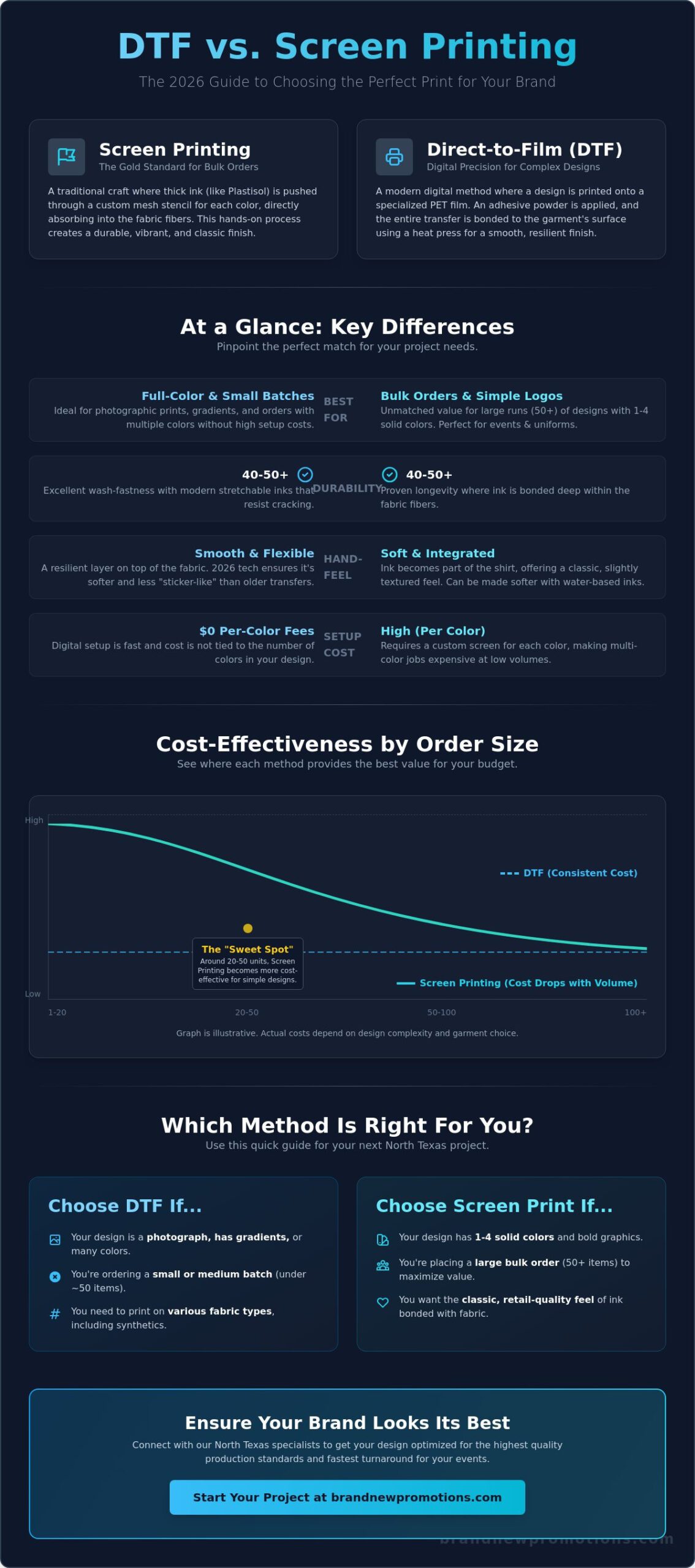
Deciding between DTF vs screen printing is a strategic choice for your organization’s procurement. While quality is vital, your bottom line often dictates the final decision. The “break-even” point between these two methods depends heavily on your design’s color count and total quantity. For a simple 1 or 2-color logo, screen printing usually becomes the more cost-effective option once you hit the 75 to 100-unit mark. However, if your artwork features five or more colors, DTF can remain the smarter financial choice for orders up to 300 units or more. This flexibility allows you to maintain high standards without overextending your budget.
Design complexity is where digital technology truly shines. DTF handles photographic details, complex gradients, and unlimited colors without increasing your unit price. Traditional screen printing requires a separate screen for every color. This can quickly exhaust a marketing budget if your logo is colorful. If your brand relies on vibrant, multi-colored graphics, the digital path offers incredible value. We focus on providing bulk value for businesses, ensuring you don’t overpay for setup fees when a modern solution is available for your custom products. For a deeper look at how to maximize your investment, our guide on bulk custom t shirts for business walks you through every key decision point for professional branding in 2026.
Analyzing the Total Cost of Ownership
Setup fees are the primary variable in professional printing. Screen printing involves labor-intensive prep for each color, including mesh stencils and physical ink mixing. This makes high-volume orders of 500 pieces or more significantly cheaper per unit than other methods. To help you navigate these variables, we’ve created the Ultimate Bulk Screen Printing Checklist to streamline your ordering process. By understanding how color count influences pricing, you can make a choice that protects your budget while delivering premium standards.
Matching the Method to the Merchandise
Professional Bulk Printing in North Texas: The BRAND NEW Promotions Edge
Choosing between DTF vs screen printing doesn’t have to be a stressful decision for your organization. We bring local expertise to every project, serving businesses from Plano to Dallas and across the entire North Texas region. Our team understands that you need more than just a printer; you need a dependable partner who values your brand as much as you do. We take the technical burden off your shoulders by analyzing your artwork, garment choice, and budget to select the perfect method. This proactive approach ensures you receive high-quality branded gear that meets your exact standards every time.
Our “No Guesswork” Guarantee means we handle the difficult technical choices for you. If your multi-color logo is better suited for the precision of digital film, we’ll tell you. If your high-volume event requires the classic efficiency of a traditional press, we’ll guide you there. We specialize in streamlined bulk ordering for corporate teams, local schools, and non-profit organizations. By focusing on your specific goals, we deliver a final product that combines durability with professional aesthetics. You can focus on your event while we handle the production details.
Why Local Partnership Matters
Working with a local North Texas partner provides distinct advantages that national websites simply can’t match. We offer personalized service for brands in Frisco, Wylie, and Richardson, ensuring your vision is never lost in a digital queue. Proximity allows for faster turnaround times and significantly reduces the shipping stress associated with tight deadlines for local events. We maintain strict quality control across both our digital and traditional production lines. This hands-on oversight means every custom t-shirt and hoodie meets our premium standards before it ever reaches your door.
Your End-to-End Branding Partner
Reliability is the anchor of our business. We take pride in being a stable resource for organizations looking to grow their identities through high-quality custom products. Our commitment to excellence means we never cut corners on ink quality, adhesive strength, or garment selection. Beyond apparel, a complete event presence also means investing in custom event tents with logo that command attention and reinforce your brand at every outdoor activation. We invite you to experience a branding journey where professional performance meets interpersonal warmth. Ready to start your next project? Get a custom quote for your bulk project today!
Ready to Elevate Your North Texas Brand?
Choosing between DTF vs screen printing depends on your specific goals. You now know that screen printing wins for massive bulk simple orders, while modern DTF technology offers incredible detail for complex logos without high setup fees. Both methods now provide the 50+ wash durability your brand requires for long-term use. We’ve served the North Texas community since our inception. Our team brings deep expertise in both digital transfers and traditional methods to every project. We provide dedicated graphic design support to ensure your artwork looks perfect on any garment you choose.
This personalized care helps you move from initial concept to final delivery with total confidence. We’re ready to handle your next project with the craftsmanship and reliability you deserve. Choosing a local partner ensures your brand gets the attention it needs to stand out in a crowded market. Request a Professional Bulk Printing Quote for Your North Texas Business. We look forward to building something great together.
Frequently Asked Questions
Which is more durable, DTF or screen printing?
Both methods offer exceptional durability when handled by professional craftsmen. Screen printing is traditionally known for its longevity because the ink sits deep within the fabric fibers. However, modern DTF transfers use advanced adhesive powders that create a resilient bond on the garment surface. You can expect both methods to remain vibrant and intact through dozens of laundry cycles without significant wear.
Is DTF printing cheaper than screen printing for bulk orders?
The cost-effectiveness of DTF vs screen printing depends on your design’s complexity and the total number of items. Screen printing is typically the most economical choice for large runs of 200 pieces or more with limited colors. DTF saves you money on mid-sized bulk orders that feature many colors or gradients because it eliminates the expensive per-color setup fees associated with traditional screens.
Can you screen print a photo or high-detail gradient?
We can achieve high detail through a process called simulated process printing, but it requires many screens and complex setup. DTF is the superior choice for photographic images and smooth gradients. It utilizes digital precision to capture every tiny detail and color shift in your logo without the technical limitations or high costs of traditional screen separation.
Does DTF printing feel like a thick sticker on the shirt?
Modern 2026 DTF technology has eliminated the heavy, plastic feel of early digital transfers. We use thinner ink deposits and micro-perforation techniques to ensure the design feels smooth and flexible on your custom t-shirts. While you can still feel the design on the surface, it moves naturally with the fabric and won’t feel like a stiff or uncomfortable layer during all-day wear.
What is the best printing method for 100% polyester sports jerseys?
DTF is the ideal choice for custom jerseys and performance wear made from 100% polyester. It bonds effectively to synthetic fibers at lower temperatures, which prevents the fabric from scorching or the dye from bleeding into your design. This method ensures your custom sports uniforms stay lightweight and flexible while maintaining crisp, vibrant branding through every game.
How many washes will a DTF print last in 2026?
You can expect a high-quality DTF print to last between 40 and 50+ washes before showing signs of aging. This puts it on par with professional screen printing standards for corporate and promotional gear. We use premium inks and industrial heat presses to ensure the adhesive fully cures, which prevents the peeling or cracking often seen in lower-quality retail transfers.
Do you offer screen printing near Plano for large corporate events?
We provide comprehensive screen printing and promotional marketing services for businesses in Plano, Dallas, and the surrounding North Texas areas. Our team specializes in high-volume production for corporate trade shows, community festivals, and school spirit wear. We take pride in being a local partner that understands the specific needs and timelines of our regional clients.
Can I mix DTF and screen printing in the same bulk order?
Yes, you can absolutely combine these techniques to get the best value for your project. We often help clients use screen printing for a large run of custom branded hoodies while using DTF for complex logos on matching custom event tents with logo or hats. This hybrid approach allows you to maintain brand consistency across different products while keeping your total project costs within budget.